Cameras That Sign Their Photos
As we’re being overrun by AI slop, it’s getting harder and harder to tell what’s real. Now, more than ever, we need methods for certifying the provenance of information. One way to do this is to have your camera’s chip digitally sign every image it creates. Then you’d have a cryptographic guarantee that this image came from a genuine Canon camera. This would allow anyone to verify, later, that these bytes were actually produced by a real camera (and hadn’t been altered since).
This is much stronger than AI detection, where detectors try to guess, after the fact, whether some content was AI generated.
Hardware-based signatures allow you to prove that certain images were not algorithmically generated.
Hardware-based signatures are also very different from watermarks
like the one Anthropic now adds to Claude’s text.
For signatures, any change to the content invalidates the signature, whereas watermarks are designed to be robust against minor changes to the content.
The main standard for this is C2PA, from the Coalition for Content Provenance and Authenticity, which Adobe, Microsoft, the BBC and others founded in 2021. Its signatures are marketed as “Content Credentials.” A number of popular cameras already support this standard (see Who is doing it today for a list). It’s also easy to verify these signatures, and I’ve built a verifier into this post so you can check provenance yourself (see Check a photo yourself).
Signatures from hardware sensors
Digital signatures can prove provenance but not accuracy. A digital signature on a piece of text proves who signed it. It says nothing about whether the text is true.
In the case of images, however, proving that an image came from a camera (or sensor) actually says something about its veracity. If a signature comes from a hardware sensor, then this is a claim about a physical measurement. Unfortunately, as we’ll see below, most cameras don’t sign at the sensor level, but later on in the pipeline (see Where the signature happens). Of course, even a sensor signature only proves what the sensor saw. Kevin Bacon and Ethan Hawke look notoriously similar so a signed photo might look like Kevin Bacon, but the signature can’t tell you whether it was actually Ethan Hawke. Still, a digital signature from a hardware sensor typically does more to authenticate the veracity of a piece of content than the signature from a piece of software.
Consider the software side. Photoshop, for example, can attach Content Credentials to its exports. In that case, it looks like Adobe’s software doesn’t have a signing key, but instead asks Adobe’s cloud servers to sign the image (Lightroom Classic says Content Credentials “require an active Internet connection.” indicating that the signing is happening in the cloud). To check this, I extracted the certificates from two Photoshop exports in Adobe’s own test files, and Adobe’s signing certificate in them is a single company-wide one, “CN=Adobe C2PA.” That suggests the signing key lives on Adobe’s servers, and that Photoshop asks those servers to sign whatever edit history it reports. As image-forensics researcher Neal Krawetz put it in 2024, “it’s relatively easy to get a service provider, like Adobe or Microsoft, to sign anything.”
A camera can do better, because its signing key can live in dedicated hardware. Each Leica M11-P gets its own certificate during production, written to the camera’s security chip. The Pixel 10 keeps its signing keys in StrongBox on the Titan M2 chip.
Although we’re focusing on signing images from cameras, C2PA itself covers much more than cameras. It defines a signed edit history that any software can extend, and AI image generators such as OpenAI’s use it to label their own output.
Who is doing it today
| Device | What it signs |
|---|---|
| Leica M11-P and later models | Every photo, if enabled. The M11-P was the first camera to do this, in 2023. |
| Sony (α1, α9 III, α7 IV and others) | Photos and video, with a paid licence sold to news organizations |
| Canon EOS R1 and R5 Mark II | Photos, with paid activation for news agencies |
| Nikon Z6III | Launched August 2025, then suspended a week later (see below) |
| Google Pixel 10 | Every JPEG photo, by default |
| Samsung Galaxy S25 | Images created or edited with generative AI |
| Qualcomm Snapdragon | The chips support signing, but I found no phone maker that ships it |
Apple has gone its own way. The iPhone 18 Pro uses a different scheme, Apple Reference Image, which I’ll cover in a separate post.
Where the signature happens
Modern cameras do a lot of work between the sensor and the final output image. They convert raw sensor values into colors, and a phone also merges several frames and runs machine-learning models. C2PA cameras sign the output file at the very end of that pipeline.
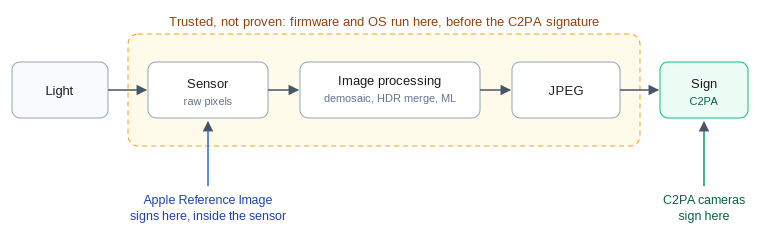
Everything before the signature is trusted, not proven. If an attacker controls the firmware or the operating system, the key will sign whatever image it is handed. This type of attack was demonstrated on the Nikon Z6III. The Nikon’s multiple-exposure mode would overlay a raw file from outside the camera onto a black frame and sign the result, so the camera produced valid signatures for images it never captured.
Apple closes this gap by signing inside the sensor. But signing inside the sensor introduces a new problem. The sensor does not produce a viewable image. Something still has to develop it into a JPEG and sign the result, and Apple does that step in its own data centers. So in Apple’s model the signature on the raw image comes from the sensor, but the signature on the final image (which is the signature most users will check) comes from Apple’s cloud servers. This is still more secure than the Adobe example above because Apple will only sign images that came from raw sensor data that was signed by one of Apple’s phones.
The certificate chain
In order to verify a signature, you need to know the signer’s public key. C2PA handles this using ordinary public-key infrastructure, much like the certificates behind HTTPS. The image file carries the signature, the camera’s own certificate (the leaf) and the certificate of the authority that issued it (the intermediate). The verifier already holds a list of trusted certificates, mostly roots, and it accepts the photo after verifying the chain of signatures from the root to the leaf. Here are two real chains, taken from a Pixel 10 photo and a Leica M11-P photo.
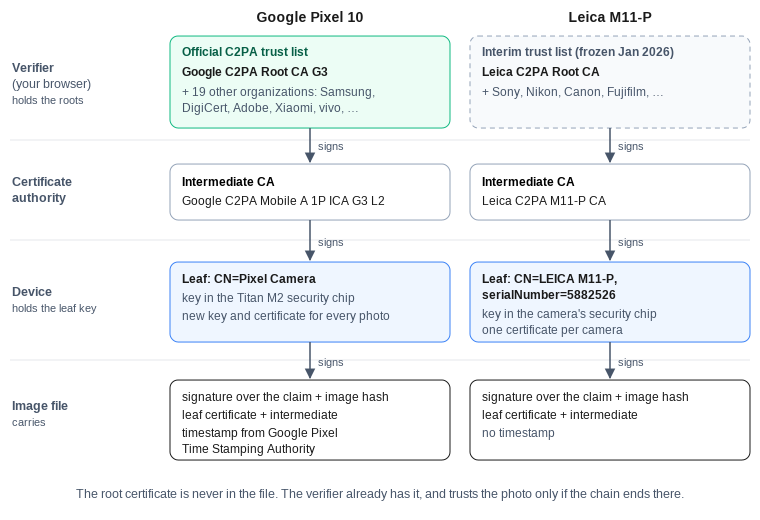
The C2PA keeps an official trust list. In November 2026 it held 34 certificates from 20 organizations, including Google, Samsung, Xiaomi, vivo and certificate authorities such as DigiCert. No dedicated camera maker is on this official list. Leica, Sony, Nikon, Canon and Fujifilm each run their own root certificate, and those roots appear only on an older interim list, which Adobe’s Content Authenticity Initiative froze in January 2026. A verifier that loads only the official list sees a Leica photo’s chain up to a root it doesn’t recognize, and reports the photo as untrusted.
The Pixel photo also carries a timestamp from a Google timestamp authority, which proves when the signature was made. That matters because the photo’s leaf certificate expired in November 2025. The signature still verifies, because the timestamp shows it was made while the certificate was valid. The Leica photo has no timestamp, so the camera’s clock is the only record of when it was taken.
Privacy
Look at the Leica leaf certificate again. It contains the camera’s serial number (5882526, for the Hackaday cat photo), so every photo that camera signs can be linked to every other. For a photojournalist working somewhere dangerous, that is a real risk, and the C2PA’s own threat model warns that a rare certificate can “uniquely identify the human along with correlating data, or at least the device itself.”
The Pixel avoids this. It generates a new key and certificate for every photo, and Google says “each key and certificate is used to sign exactly one image.” The C2PA’s threat model suggests this approach but does not require it.
Although unique keys for each photo provide privacy, they also create a revocation problem. If Google learns that a phone was compromised, it can only revoke certificates one photo at a time. Group signatures and anonymous credentials would give both properties, unlinkable photos and revocation by device, but C2PA allows only ordinary signature algorithms.
The signature is also not the only thing that leaks. The Pixel photos I used for testing record which compass direction the camera faced, and a Pixel with location turned on also records GPS coordinates, outside the part of the file the signature covers. An edited image can keep a thumbnail of the original inside its edit history, so a face you blurred may survive in the thumbnail.
Check a photo yourself
The verifier below runs Adobe’s open-source C2PA library, c2pa-rs, inside your browser. Your file is never uploaded. It checks the signature against both trust lists and tells you which one the signer chains to. It does not look up revocation online, because that lookup would tell the certificate authority which certificate you are checking.
To try it, you need a file that still has its credentials, and most images online have lost them (more on that below). Krawetz posted unaltered Pixel 10 originals, including two out-of-camera samples from DP Review. Hackaday published two cat photos, both claiming to come from a Leica. One really does, and the other was taken with a Game Boy Camera and signed with a homemade certificate. The verifier tells them apart.
There is also a standalone version at /tools/c2pa-verify. Other options are the CAI’s Verify site and the c2patool command-line tool.
Attacks
Anyone can photograph a screen showing a fake image, and the camera will faithfully sign a true picture of a false scene. The C2PA’s threat model acknowledges this. Sony’s cameras record 3D depth information to mitigate this attack.
An attacker can also feed the signer an image it never captured, as with the Nikon. Nikon revoked the affected certificates, but C2PA does not require verifiers to check revocation, and the popular tools don’t. Six months later, three of four verifiers still accepted the forged Nikon image.
On a phone, root access is enough. David Buchanan showed that even root access cannot pull the key out of the Pixel’s secure chip, but a rooted phone can simply ask the chip to sign any image as “Pixel Camera.” Google closed his report as “Won’t fix (infeasible).”
Finally, edit histories can lie. An editor’s signature covers only what the editing software says it did. So a compromised or careless editor could attach any image to a genuine camera signature and call it a crop.
Even with these caveats, C2PA signatures are a step in the right direction. The real utility of signatures like this is for people to get a quick verification of whether a social media post is real. In these situations, the attacks described above are probably not worth the effort. On the other hand, these attacks mean that C2PA signatures alone are not sufficient proof in a high-stakes situation like a court case or serious news investigation.
The real problem is distribution
It’s great to have cameras sign images. The hard part is keeping credentials attached to the image as it moves around the internet. When the Washington Post uploaded a signed video to eight platforms in October 2025, none of them kept the credentials or let users see them. X strips all embedded metadata on upload. A November 2026 crawl by ProofSnap, an evidence-capture company, found credentials on 3 of 1,331 images from 55 websites, and only one of those still matched its file.
On the positive side, California’s ban on stripping takes effect in January 2027. Until platforms keep the signatures, signing on the camera does little against misinformation on social media.
Editing photos
One problem with a signed image from the camera is that most people want to edit the photo before distributing it, and any edit will invalidate the signature. There are a number of possible mitigations to this problem.
The simplest is to just publish the original image (with its signature) next to the edited version, so people can see for themselves if they think the editing captured the spirit of the original. Another possibility is to have the editing software sign its edits (for example, a crop or a resize). Some of Adobe’s products do this, but as noted above this means that the trust is now transferred to the editing software, and compromised editing software could lie about its modifications. Finally, on the cryptographic side, research systems such as VerITAS and VIMz produce zero-knowledge proofs that a published image is a crop, resize or filter of a signed original, without revealing the original. Unfortunately, none of these systems handles the processing from a raw image to a JPEG, and none is in production.